

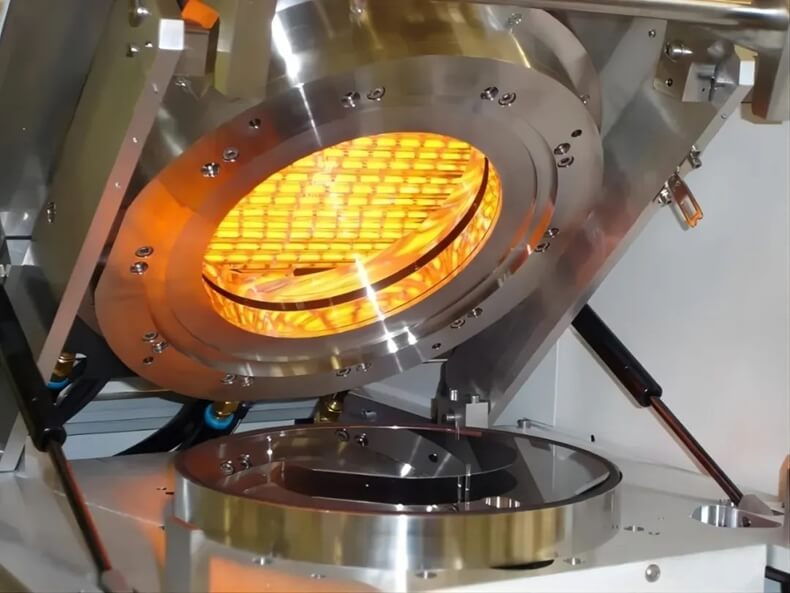
On the lithography floor, you see the queue stack up the moment the bake step starts to drift. Soft bake temperature that’s off by even a hair, and critical dimension control slips out of spec. Hard bake nonuniformity shows up later as edge bead, resist failures, and a headache you don’t need. You’re running the line, you’re watching the thermal budget, and there’s no room for guesswork. The compact infrared dryer for IC was built for that reality. This isn’t a general-purpose heater. It’s a wafer-level thermal tool designed to meet semiconductor-grade demands: cleanroom compatibility, particle control, and repeatable temperature performance, period.
What actually matters under the hood
We built the system around infrared emission tuned for fast, controlled heating with minimal thermal inertia. The emitter choice is deliberate: short-wave infrared, paired with a quartz-based optical path and reflector geometry that puts the energy where it needs to be—on the wafer—without cooking the surrounding hardware. The spec you care about is temperature uniformity: ±0.1°C across the wafer plane. That isn’t a brochure number. It comes from closed-loop control that combines high-resolution sensor feedback, a stable emitter drive architecture, and an optimized thermal profile strategy. The payoff is repeatability you can log and stand behind during an audit. Cleanroom behavior is engineered into the hardware. The body uses materials and finishes that belong in Class 1–100 environments, with sealed seams and a particle-controlled airflow path. We spec low outgassing components and a filter strategy that keeps particle generation at the point of use below what the process can tolerate. In practice, that means fewer yield hits tied to contamination and less schedule risk during qualification. Thermal response speed matters. Infrared heating delivers rapid energy transfer, which shortens ramp-up and soak time. That helps throughput, but it also matters for photoresist integrity: you want the resist to hit the target temperature fast and hold it, not drift through a wide thermal band that drives solvent loss unevenly. Electrical integration is clean. The unit supports standard voltage inputs in a compact footprint, with straightforward cabling that lets you place it close to the process cell without crowding the workspace. Footprint and connector details are chosen to fit both retrofits and new installs.
Why this tool earns its keep on the floor
In semiconductor manufacturing, the dryer isn’t a standalone step—it’s a process stabilizer. In photoresist processing, soft bake controls solvent evaporation and sets the stage for exposure latitude. Hard bake stabilizes the resist before etch or implant, shaping edge profiles and adhesion. When the bake is uneven, you get CD shifts across the wafer, edge bead issues, and pattern collapse at tight geometries. With ±0.1°C uniformity, the compact infrared dryer turns those failure modes into background noise. The tool fits the constraints of modern fabs. It runs in cleanroom environments without forcing you to add buffer zones or rework utilities. It produces repeatable bake curves, which makes qualification and requalification predictable. When you transfer a process from development to pilot to volume, the thermal signature stays consistent. Reliability comes down to uptime. The emitter architecture is chosen for long life and stable output, and the control loop holds setpoint despite line voltage fluctuations and ambient thermal load. That stability cuts unplanned interventions. Fewer interventions mean fewer line stops, fewer lot holds, and fewer scrap wafers needed just to prove the process is still in control. Energy use isn’t an afterthought. Infrared heating is directional, so less energy is wasted heating the frame and exhaust. In a dense fab with many thermal stations, that efficiency shows up as lower operating cost and lower thermal load in the cleanroom.
The practical details you plan for
This dryer is compact, but it still needs planning. Mounting and clearance have to be respected. You need adequate service access for maintenance and sensor calibration, and the exhaust path must be routed to maintain cleanroom pressure differentials. If you’re retrofitting an older cell, verify the available footprint and make sure the exhaust ducting matches the tool’s flow requirements. Process matching is straightforward, but it isn’t automatic. The best results come from mapping the thermal profile to the resist stack and the substrate. We provide standard qualification routines, but the final recipe belongs to your process. Expect to tune ramp rates and soak times to the resist chemistry and device layers. Emitter life is finite. It’s long—enough for high-volume operation—but it is a consumable. Plan replacement intervals and keep spares on hand. That’s not a weakness; it’s honest engineering. Treat it like any scheduled maintenance item, and the line won’t be caught off guard. If your facility has strict electromagnetic compatibility constraints, confirm the electrical interface and shielding requirements during integration. The control electronics are designed for the factory environment, but coordination with site standards is part of a smooth install. When the bake step has to hold inside a tight thermal window, the compact infrared dryer for IC gives you control, repeatability, and cleanroom-native operation—without forcing your process to bend.